Transcript
Hey, I’m Jay and me and my co-founder Andrey, we were running a bunch of coding agents on our own stuff and at first we just we kept all the work in a few markdown files in the repo, which is fine until it isn’t. So, then we moved everything into Linear and it just kept falling apart on us.
Because Linear’s brilliant, but it’s built for people. It assumes there’s a human driving and when you’ve got all your agents going at once, that human is you. So, we built the thing we actually wanted. An issue tracker where the agents just ask for work and the server hands it out. And yeah, we were only building it for us, but turns out a lot of people have the same problem and here we are.
Introducing Retasc. Okay, so this is Retasc. It’s an issue tracker, but the thing that actually uses it isn’t me, it’s the agents. So, this is the dashboard and this here is the queue and there’s six issues sat in the backlog right now. Let me open one. So, you get the title, the description, what’s happened to it. It’s a normal issue, nothing clever about it, but the interesting bit isn’t what’s in here, it’s how it got here and what the agent had to write down on the way.
So, let me add a few more and you’ll see what I mean. So, left is Claude Code, right is the dashboard and I’m not writing tickets, I’m just going to talk to it. Okay, so there’s a tool in my extra folder called hn-discover. It sweeps Hacker News for keywords into a SQLite file. I want it living in this project instead.
So, file me four issues. One, port it in and get it building. Two, write the keyword tiers for it. Ours not extras. Three, add Reddit as a second source. Four, run it on a schedule and file whatever it finds as issues in here. And that fourth one needs the first two done before it can start. Just file them, don’t start anything.
Right, so while that’s going, let’s talk. How do people actually do this now? Two ways, mostly. Either you keep the work in a markdown file in the repo and you point your agents at that or you’ve already got a proper tracker, Linear, Jira, whatever and you wire it up over MCP and both of them break in the same place.
So, the file, nothing’s stopping two agents reading the same line and both going off and doing it. There’s no lock. There’s nothing anywhere that says this one’s taken. And the tracker does actually know about dependencies, but only if a human sat down and added them. And even then, all it does is show you a little icon saying this one’s blocked.
It’s for you to look at and make a call on. Nothing reads that graph and hands work out. Assignment is still a human picking someone and dragging a card across. So, either way, you’re it. You’re the lock. You’re the scheduler. And you’re the one who notices an hour later that two agents stomped on each other’s work or that one of them quietly died.
That’s not a coding problem. That’s coordination. And it’s the only part of this that still runs at human speed. And the agents file them. Look at the backlog. There they are. Four more. And notice what it had to do. It can’t file an issue without saying what that one depends on. Retasc rejects the call. So, the order that was only in my head like 30 seconds ago, it’s on the board now.
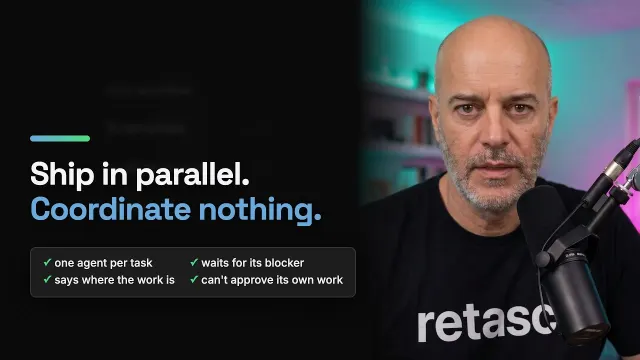
And every agent after this can see it, which is why that fourth one already says blocked. So, three agents. This one’s Claude Code. This one’s Codex. And this one’s another Claude. And they all get the exact same sentence. First for Claude Code, take the next issue. Now, for Codex, pressing next issue. Now, last one, the same, take the next issue.
And now, let’s watch the dashboard in the active tab. Issues will go from backlog to active. Same instruction. Three different issues. And they still can’t see each other, but they don’t actually need to. Each one asked, the server answered, and the moment it answers, that issue is locked. Another agent asking for it just gets refused. So, that’s the first thing off me.
I’m not handing work out anymore. And look at that. That fourth one’s still sitting in backlog. So, let me actually try to take it. In Linear or Jira, I could just cherry-pick it, right? Try taking SIG-10. Yeah. Refused. And that’s not the agent being careful. It asked and the server said no because the two things it depends on aren’t done yet.
So, nothing gets handed out that can’t be finished and there’s no way to take it either. That graph isn’t decoration, it’s what hands the work out. And again, I didn’t have to think about any of that. And quick thing, I’ve been showing you this dashboard the whole time, but I don’t actually need it. Same queue from the terminal.
List, show, claim, done, checkpoint. It’s all there. So, if you never want to leave your terminal, you don’t have to. And the agents were never looking at either one anyway, they go straight over MCP, so this board is just me watching. It’s not where the work happens. And last thing on these, so remember the one that quietly dies?
Each of these claims is a 30-minute hold. It’s not ownership. The agent keeps it by checking in while it works. So, if it stops, the hold just expires. And the issue drops back in the pool by itself. And it doesn’t come back empty. The agent’s been writing down how far it got as it went, so the next agent just carries on from there instead of starting the whole thing over from scratch.
Oh, and couple of things before I stop. So, we have notifications. Slack, Discord, Telegram, your agents move an issue, you get a DM. So, you’re not, you know, sitting here staring at a board all day. And it’ll keep GitHub issues in sync as well if that’s where your team already lives. And then this one here, migrate. So, if you’ve already got a backlog in Linear or Jira, ClickUp, Asana, or Shortcut, it pulls the whole lot across in one go.
And by the way, we’re adding more migration connectors soon. So, you’re not sat there typing your backlog in by hand. Look, if this looks like Linear, that’s kind of on purpose. It’s the same shape, right? Issues, dependencies, a board. The difference is we try to strip out all the human ceremony from the middle of it. So, in Linear, a dependency is a little warning icon that tells you not to start something.
In Retasc, it’s the dispatcher. Nobody assigns anything, nobody drags anything between columns. The agents just ask and the server dispatches. So yeah, that’s basically it. You describe the work, an agent files it, and then they just take it from there. You’re not going to be the bottleneck in the middle anymore, which was, you know, the whole point.
Try it at retasc.com, and Claude Code, Grok, Codex, Cursor, anything that speaks MCP just connects and you’re good to go in 60 seconds. So that was just a quick intro, really. We barely scratched the surface here. There’s a lot more, so we’re going to do more videos, feature after feature proper tutorial style, just us actually using it one thing at a time. So, yeah, thanks for watching.